Mara Wolf · 19 November 2026
Bandwidth Allocation Strategies Within Quaycloud's Scalable Architectures
Cloud service providers manage network resources through structured approaches that balance demand across distributed systems, and Quaycloud applies these principles within its scalable setups to handle variable traffic loads. Data centers operated by the company route packets according to predefined policies that adjust based on real-time usage patterns, which helps maintain consistent throughput even during peak periods.
Core Principles of Bandwidth Distribution
Bandwidth allocation begins with monitoring tools that track data flow rates across virtual networks, and Quaycloud integrates these tools directly into its orchestration layers. Observers note that this integration allows for immediate detection of congestion points, after which automated scripts redistribute available capacity among active nodes. Research from the National Institute of Standards and Technology highlights how similar monitoring frameworks improve overall resource utilization in large-scale environments.
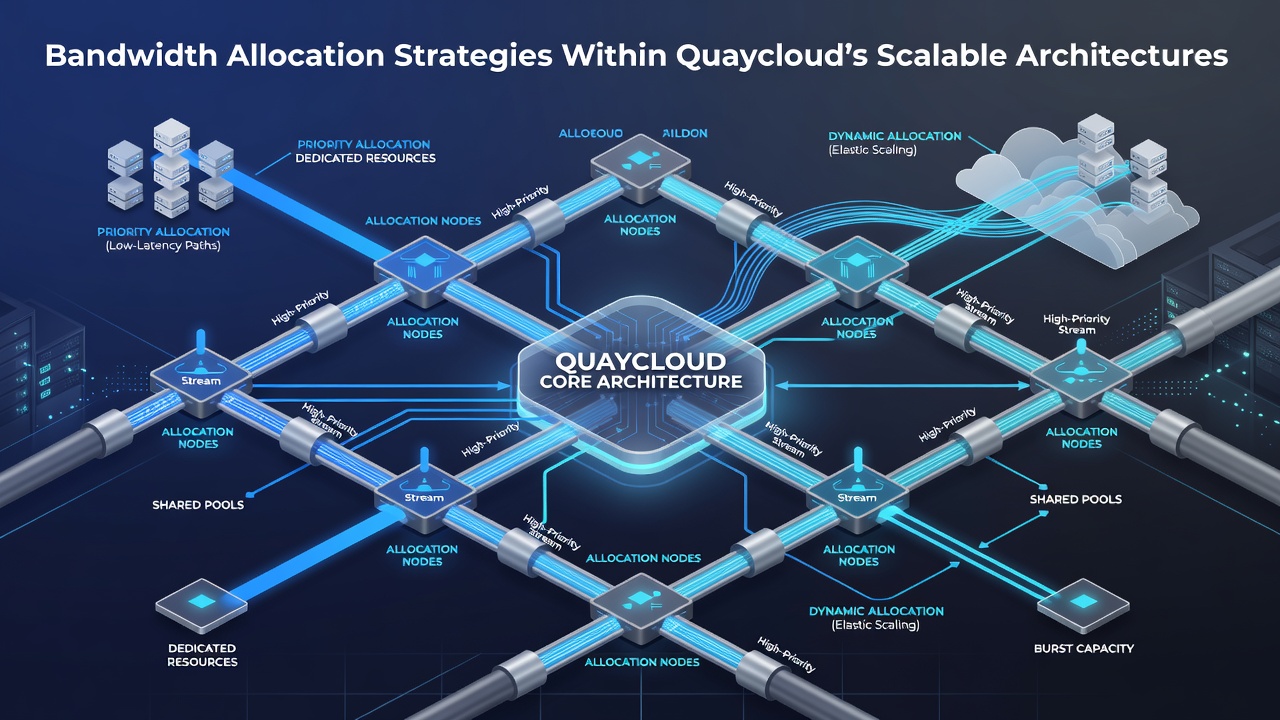
Priority mechanisms form another layer, where certain workloads receive guaranteed minimum allocations while others share remaining capacity on a best-effort basis. Those who've studied Quaycloud's documentation find that these mechanisms rely on class-of-service tags embedded in packet headers, which routers evaluate during forwarding decisions. This tagging system operates continuously, and adjustments occur without interrupting ongoing sessions.
Scalable Architecture Components
Quaycloud builds its platforms around containerized microservices that scale horizontally, and bandwidth controls extend across these instances through centralized controllers. The controllers maintain a global view of network topology, which enables them to shift allocations when new instances spin up or down. In practice, this means a sudden increase in user requests triggers proportional bandwidth grants to newly provisioned resources while existing ones retain their shares.
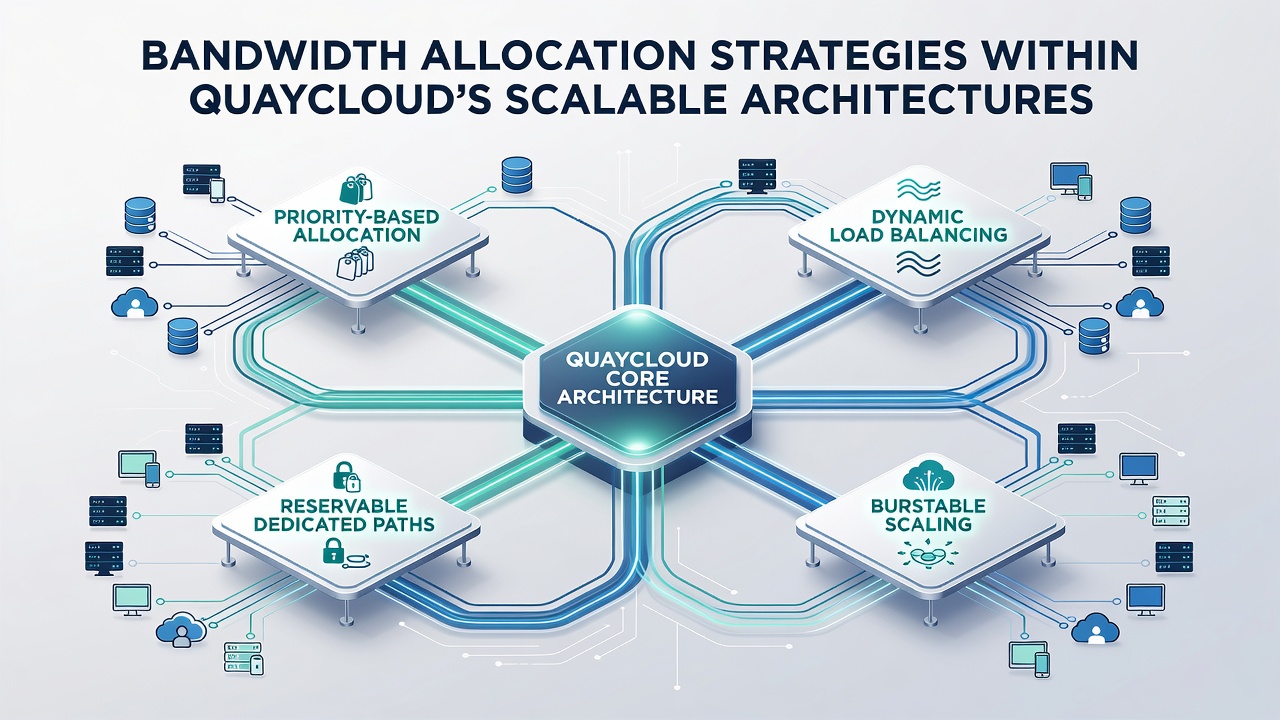
Load balancers play a direct role by inspecting incoming connections and directing them toward paths with available headroom, and Quaycloud configures these devices to incorporate bandwidth metrics alongside traditional CPU and memory data. Experts have observed that combining these metrics reduces the frequency of throttling events across the fleet. November 2026 saw an update to the load balancing algorithms that incorporated machine learning models trained on historical traffic traces, further refining distribution accuracy.
Implementation Techniques in Practice
Dynamic reservation stands out as a primary technique, where applications declare expected bandwidth needs during deployment and the platform reserves slices accordingly. If actual usage falls below reservations, unused portions become available for other tasks through a borrowing process that reverts when demand spikes again. Quaycloud implements this through software-defined networking overlays that enforce reservations at the hypervisor level.
Traffic shaping complements reservations by smoothing bursts that could overwhelm downstream links, and the company applies token bucket algorithms configured per tenant. These buckets refill at rates matching purchased plans, which prevents any single customer from monopolizing shared infrastructure. Data from the European Union Agency for Cybersecurity indicates that such shaping methods contribute to stable performance in multi-tenant clouds when calibrated correctly.
Failover paths receive special consideration during allocation planning, and Quaycloud maintains secondary routes with pre-allocated bandwidth that activates automatically upon primary path degradation. Redundancy calculations factor in geographic distribution of data centers, ensuring that regional outages do not cascade into widespread slowdowns. Those managing large deployments often discover that pre-allocation reduces recovery times compared to on-demand provisioning.
Performance Tracking and Adjustments
Continuous telemetry feeds performance dashboards that display per-application bandwidth consumption alongside latency and packet loss figures, and Quaycloud engineers review aggregated trends weekly to identify optimization opportunities. When patterns emerge, such as recurring evening spikes in certain regions, allocation policies receive targeted updates without requiring full system restarts. This iterative process keeps the architecture aligned with evolving usage habits.
Capacity forecasting models project future requirements based on growth rates observed across similar deployments, and the company refreshes these models quarterly using the latest telemetry sets. Forecasts inform procurement decisions for additional backbone links, which in turn support expanded allocation pools. The approach avoids over-provisioning while maintaining headroom for unexpected surges.
Conclusion
Quaycloud's bandwidth allocation strategies combine monitoring, prioritization, reservations, and shaping within a horizontally scalable framework that adapts to changing conditions. Updates introduced in November 2026 enhanced these capabilities through refined algorithms and expanded telemetry coverage. Organizations evaluating cloud platforms encounter these methods as standard components of modern infrastructure, and ongoing refinements continue to align allocations with actual demand patterns across distributed environments.